


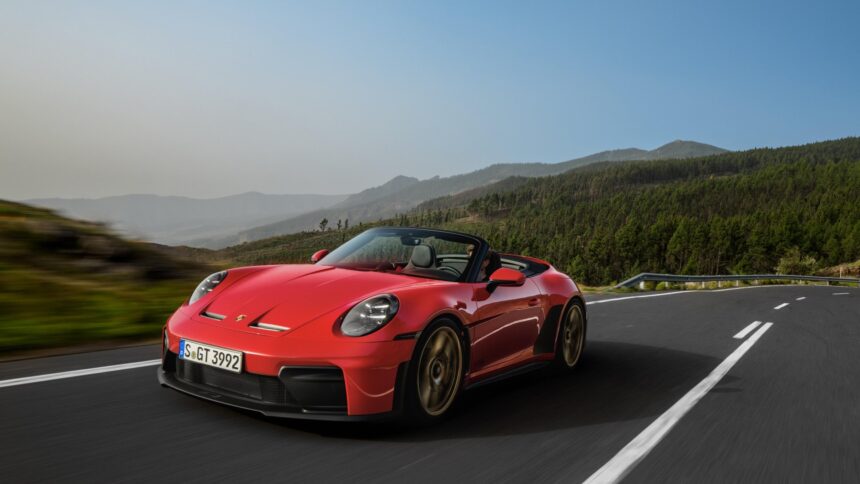
Porsche has just unveiled the 2027–model 911 GT3 S/C, a landmark new variant that marks the first fully automatic‑roof convertible in the GT3 family. Built for purists who love high‑revving, naturally aspirated thrills under open skies, the S/C blends the lightweight philosophy of the 911 S/T with the hardcore spec of the standard GT3—but with two seats, no rear‑seat clutter, and a roof that disappears at the press of a button.
Design & Exterior: Surgical GT Guts, Open‑Sky Freedom
The 911 GT3 S/C inherits the aggressive GT3 body with its wide rear haunches, rear‑deck wing, and functional aerodynamics, but ditches the fixed roof for a fully automatic soft‑top that stows neatly in the rear deck. Porsche quotes a kerb weight of around 1,497 kg—only about 30 kg more than the earlier manual‑roof Speedster—thanks to carbon‑fibre‑reinforced‑plastic (CFRP) bonnet, fenders, and doors plus magnesium‑based roof elements and centre‑lock wheels.
Key visual cues include:
- Double‑wishbone front axle carried over for sharper turn‑in and GT‑level precision.
- No rear seats; the S/C is a pure two‑seater, mirroring the spirit of the 2019 Speedster while dropping the limited‑run aura.
- Optional Street Style Package in Pyro Red graphics, side badging, and interior accents for owners who want the car to stand out on the road as much as on the track.
Powertrain & Performance: 4.0‑Litre Flat‑Six, 510 PS, Manual Only
At the heart lies the familiar 4.0‑litre naturally aspirated flat‑six, tuned to deliver around 375 kW (510 PS / 502 hp) and about 450 Nm (331 lb‑ft) of torque, revving freely to 9,000 rpm. Crucially, this engine is paired exclusively with a short‑ratio six‑speed GT Sport manual transmission, keeping the S/C a true driver‑focused machine.
Performance figures:
- 0–100 km/h in about 3.9 seconds.
- Top speed of roughly 313 km/h (194 mph) despite the added roof mechanism.
Porsche includes the Porsche Ceramic Composite Brake (PCCB) system as standard, which trims unsprung mass and gives stronger, fade‑resistant stopping power on track stints.
Chassis & Handling: Track‑Sharp with Open‑Top Balance
Even with the loss of a fixed roof, the S/C keeps the GT3’s track‑bred DNA:
- Lightweight construction borrowed from the 911 S/T helps keep body roll and pitch in check.
- The double‑wishbone front axle (a first for an open‑top 911) improves turn‑in feel and steering feedback compared with previous soft‑top 911s.
Porsche also uses lightweight magnesium wheels that cut rotating mass by around 9 kg, while the cabin itself strips out non‑essentials—lightweight carpets, carbon‑fibre door pulls, and optional carbon‑fibre bucket seats—to keep the mass‑distribution and balance as rear‑engine‑pure as possible.
Interior & Tech: Driver‑Focused, with a Touch of Theatre
The cockpit is spartan but premium, with:
- Sports Seats Plus as standard; carbon‑fibre bucket seats as an option for maximum weight‑saving and lateral support.
- A rotary ignition switch to the left of the steering wheel—a hallmark of GT3 models—plus a digital instrument cluster with a Track Screen mode that prioritizes lap‑time‑oriented data.
The Street Style Package adds decorative leather and four‑tone braided seat centres, while the rear cabin can be customized with an 80‑litre lightweight luggage box trimmed in leather, giving the S/C a slight GT‑touring practicality without sacrificing its core mission.
Pricing, Availability & Positioning
European reports peg the 911 GT3 S/C’s starting price around €269,000, positioning it as a high‑spec, low‑volume GT3 variant rather than a limited‑edition special. Porsche markets it as the open‑top, manual‑only interpretation of the GT3, aimed squarely at enthusiasts who want the raw sound and feel of the naturally aspirated flat‑six with the liberation of open‑air driving.
Why It Matters in the GT Lineup
The 911 GT3 S/C is significant because it:
- Makes the GT3 spec available with a fully automatic convertible roof for the first time, widening the GT3’s appeal beyond coupe‑only buyers.
- Proves that Porsche can keep the car light, agile, and track‑capable even with added roof hardware, thanks to intensive use of CFRP and magnesium.
- Strengthens the brand’s manual transmission and naturally aspirated ethos at a time when many rivals are going fully electric or dual‑clutch.
Final Verdict
ith the Porsche 911 GT3 S/C, Porsche has created the ultimate open‑top GT3: a 510‑PS, 4.0‑litre naturally aspirated howler that’s only available with a six‑speed manual and a fully automatic soft‑top. It’s a car for drivers who want the track‑focused hardware of the GT3 and S/T, but with the emotional thrill of an open‑sky experience—making it one of the most desirable 911s in the current lineup for true petrol‑head enthusiasts.