


New Delhi: India’s human spaceflight programme may eventually involve much more than rockets and spacecraft. Indian astronaut Group Captain Shubhanshu Shukla has shared details of a research project focused on a crucial question for future space missions: Where will astronauts live after reaching another world?
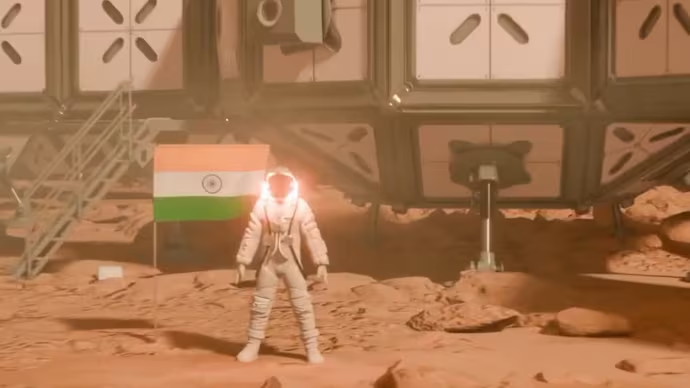
The research has produced a habitat concept called B.H.E.E.M. — Bharatiya Habitable Expandable Extraterrestrial Habitat. The project explores possible ways humans could establish living and working spaces on destinations such as the Moon and Mars.
The concept was developed at the Aloke Lab at the Indian Institute of Science (IISc), Bengaluru, as part of academic research undertaken during Shukla’s astronaut training in India.
Shukla Looks Beyond the Spacecraft
While astronaut training largely focuses on operating spacecraft and preparing for the physical challenges of spaceflight, Shukla said he wanted to think about what happens after astronauts land.
He explained that the question of where humans would actually live on another planet or the Moon is just as important as getting them there.
His research therefore shifted attention from transportation to extraterrestrial habitats and the technologies required to support people once they arrive.
The BHEEM concept explores how expandable structures could potentially form part of future settlements beyond Earth.
What Is the BHEEM Habitat Concept?
BHEEM stands for Bharatiya Habitable Expandable Extraterrestrial Habitat.
The idea focuses on creating living spaces that could be transported to another world and expanded to provide astronauts with a usable environment.
Future habitats would need to deal with some of the harshest conditions humans could encounter outside Earth.
These include:
- High levels of space radiation
- Extreme temperature variations
- Hostile surface environments
- Limited access to resources
- Long-term life-support requirements
- Energy generation and storage
- Construction and expansion challenges
A successful habitat would therefore need to be much more than a simple shelter. It would have to support the health, safety and productivity of astronauts for extended periods.
Why Habitats Are Critical for Moon and Mars Missions
Landing humans on another world is only one part of establishing a long-term presence in space.
Astronauts would need reliable protection from the environment along with systems capable of providing breathable air, water, power and other essential resources.
The challenge becomes even greater if missions move from short visits to long-duration stays or permanent settlements.
Shukla emphasised that developing these technologies cannot be left until humans are ready to establish such settlements.
His message is that research needs to begin well in advance because technologies for future extraterrestrial living could take decades to develop, test and refine.
From a Single Module to a Larger Settlement
Concept images associated with the BHEEM research show how an individual habitat module could potentially become part of a much larger settlement.
The structures could be transported using spacecraft and then arranged or expanded after reaching an extraterrestrial destination.
Such an approach could offer greater flexibility compared with attempting to build an entire settlement from scratch after landing.
Expandable habitats could potentially allow an initial mission to carry a relatively compact structure that grows as more astronauts, equipment and resources arrive.
However, the concept remains a research and design proposal rather than an operational habitat ready for deployment.
India’s Human Spaceflight Programme
The BHEEM research comes as India expands its ambitions in human spaceflight and space exploration.
The Gaganyaan programme is expected to play a central role in India’s human-spaceflight efforts, with the experience gained from crewed missions potentially supporting more ambitious exploration in the future.
As international interest in lunar exploration and Mars missions increases, technologies for living away from Earth are becoming an important area of research.
For India, concepts such as BHEEM represent an effort to think beyond individual missions and consider the infrastructure that could eventually be needed for sustained human exploration.
Shukla: Research Must Start Today
Shukla’s central argument is that humanity cannot wait until the first permanent settlements are imminent before developing the technology needed to support them.
If humans are expected to live beyond Earth in the coming decades, research into habitats, life-support systems, energy and construction methods needs to happen much earlier.
The BHEEM concept is therefore less about building a home on another world today and more about imagining and researching what such a home could eventually require.
As countries prepare for increasingly ambitious Moon and Mars missions, the next major challenge may not simply be reaching another world — but creating a safe and sustainable place for humans to stay once they get there.