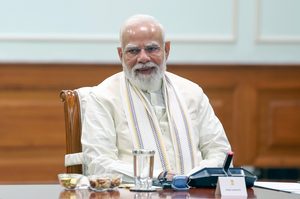


Last Man in Tower review: Manoj Bajpayee leads this intense Mumbai drama about an ageing resident who refuses to sell his home while everyone around him accepts a lucrative redevelopment offer. What starts as a property dispute gradually becomes a disturbing look at greed, pressure, loneliness and the choices people make when money is involved.
Mumbai’s redevelopment culture provides the backdrop for Last Man in Tower, a film adapted from Aravind Adiga’s novel. At its heart is a simple question: what happens when an entire building wants to move on, but one resident refuses to let go?
The film doesn’t treat the conflict as a straightforward battle between good and evil. Instead, it slowly reveals why every character believes they are justified, making the story considerably more complicated than a typical property drama.
Manoj Bajpayee plays a stubborn retired teacher
Manoj Bajpayee plays Yogesh Mishra, a retired schoolteacher living in an old Mumbai building filled with memories of his late wife.
When a builder proposes a redevelopment deal offering residents a substantial amount of money, most of the society members agree. Yogesh, however, refuses.
His argument is based on principle. He believes residents have the legal right to reject the offer and should not be forced into giving up their homes simply because everyone else has decided to sell.
But as the story progresses, his determination begins to look increasingly complicated.
Everyone has a reason to sell
One of the film’s biggest strengths is its refusal to portray the other residents as greedy villains.
Their motivations are personal and often understandable.
A mother wants better facilities and opportunities for her child with special needs. Another woman hopes to secure her daughter’s future and education abroad. Someone else needs money to clear debts.
For these people, the builder’s offer isn’t simply about getting rich. It represents an opportunity to solve problems that have been weighing on them for years.
This makes Yogesh’s refusal increasingly uncomfortable for everyone around him.
When disagreement turns into pressure
The situation becomes darker when the residents begin turning against Yogesh.
An elderly couple face violence after refusing to cooperate, while others gradually surrender to the pressure surrounding the redevelopment plan. Even Yogesh’s lawyer advises him to accept the offer and move on.
The film makes an important observation about money: its influence doesn’t stop at buying physical property. It can also change relationships, loyalties and even people’s moral boundaries.
What began as a disagreement over a building eventually becomes a battle over dignity and control.
The housing society becomes a character itself
The old residential society is one of the most interesting elements of Last Man in Tower.
Its meetings, gossip, arguments and private alliances create a believable picture of urban Mumbai life. Residents know each other’s business, judge one another and quickly form opinions.
The film also explores how society treats people who don’t fit conventional expectations.
A single woman becomes the target of gossip because male visitors frequently come to her home. Yogesh challenges this behaviour, arguing that personal privacy should not become a subject of community policing.
These smaller moments expand the film beyond redevelopment and give it a stronger social dimension.
Divya Dutta delivers one of the film’s strongest performances
Divya Dutta is particularly effective as Sangeeta Puri, a woman raising a son with special needs.
Sangeeta shares a close relationship with Yogesh, which makes her attempts to persuade him to accept the redevelopment deal emotionally complicated.
She reminds him that the society supported him when his wife was battling cancer and argues that he should now support the residents and their aspirations.
Her actions can be manipulative, but the film doesn’t reduce her to an antagonist. Dutta brings out her frustration, vulnerability, anger and desperation through subtle expressions and body language.
It is one of the performances that gives the film much of its emotional weight.
Manoj Bajpayee is outstanding as Yogesh
Bajpayee’s performance is arguably the film’s biggest highlight.
Rather than relying on obvious mannerisms to portray an elderly man, he builds Yogesh through small details — his movements, expressions, voice and body language.
Yogesh can be stubborn, intrusive and frustrating. He constantly gives unsolicited advice and believes his experience gives him the right answers.
Yet beneath that difficult exterior is a man struggling with loneliness and the fear of becoming irrelevant.
His relationship with his son adds another emotional layer. Their conversations reveal how someone can genuinely care for another person while still making it difficult for them to be around him.
Bajpayee handles these contradictions with remarkable control.
Boman Irani brings a quiet menace
Boman Irani plays the builder, but the character isn’t written as a conventional loud or aggressive villain.
Instead, he remains calm and persuasive, making his interactions with Yogesh more interesting.
The builder appears genuinely intrigued by Yogesh’s refusal to accept the money. That raises an important question: if money isn’t what Yogesh wants, then what exactly is he fighting for?
The film doesn’t provide an easy answer.
A disturbing descent into isolation
As Yogesh continues to resist, his life becomes increasingly difficult.
Basic facilities are disrupted, neighbours stop supporting him and hostility escalates. The situation eventually becomes so extreme that his home itself becomes a place of intimidation and humiliation.
The film doesn’t simply celebrate his resistance.
Instead, it asks whether defending one’s principles is always noble — or whether determination can eventually become another form of selfishness.
That moral uncertainty makes Last Man in Tower more compelling than a conventional social drama.
Mumbai beyond the postcard image
Director Ben Rekhi presents a very different Mumbai from the glamorous city commonly seen on screen.
The film focuses on ageing buildings, crowded homes, narrow spaces, neighbourhood conversations and residents watching one another’s lives.
The redevelopment conflict feels particularly relevant because the old building represents more than bricks and concrete. For some residents, it is home and memory. For others, it is an outdated space that needs to make way for a better future.
The building consequently becomes a metaphor for the characters themselves — some want to preserve the past, while others are willing to destroy it to build something new.
Is Last Man in Tower worth watching?
Yes, particularly if you enjoy character-driven dramas rather than straightforward commercial entertainers.
At roughly 97 minutes, the film keeps the narrative tight and doesn’t spend too much time on unnecessary subplots. The story steadily moves from a disagreement over property to a much deeper examination of human behaviour.
Manoj Bajpayee and Divya Dutta are the biggest reasons to watch it, while Boman Irani adds another compelling dimension to the conflict.
The ending is particularly affecting because the film refuses to provide a comfortable answer about who was right and who was wrong.
Final Verdict
Last Man in Tower works because its central conflict is surprisingly relatable. It isn’t really just about a Mumbai building or a redevelopment deal. It is about what people are willing to sacrifice for money, security, family and personal beliefs.
The film leaves audiences with two uncomfortable questions: When does ambition become greed? And when does standing up for your principles become selfishness?
Last Man in Tower Rating: 4/5