

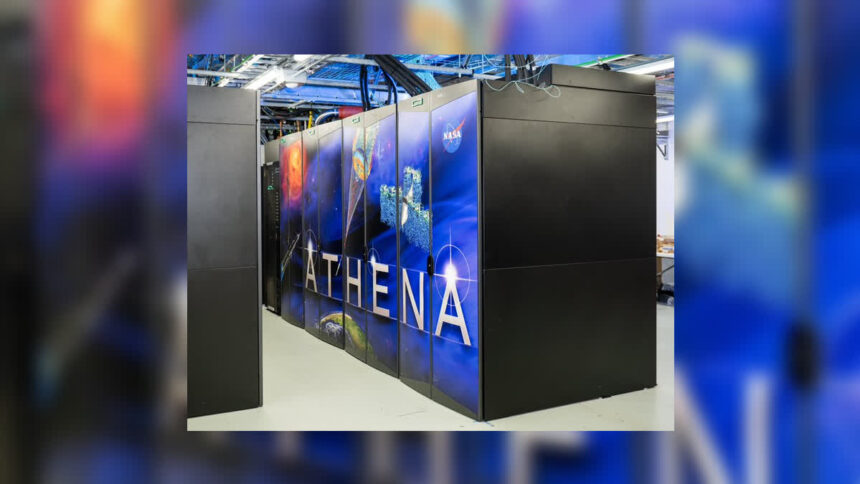
In the ever-evolving landscape of space exploration, computational might is the unsung hero behind groundbreaking discoveries. Enter Athena, NASA’s latest supercomputer, a technological marvel that promises to propel humanity’s ambitions to the Moon, Mars, and beyond. Launched in January 2026, Athena stands as the agency’s most powerful and efficient computing system to date, blending raw performance with innovative design to tackle the complexities of modern missions.
The Genesis of Athena
Athena’s story begins at NASA’s Ames Research Center in California’s Silicon Valley, where it’s housed in the Modular Supercomputing Facility (MSF). This location, less than a mile from the main NASA Advanced Supercomputing (NAS) building, allows for seamless integration with existing infrastructure. The supercomputer was brought online in early 2026, with full production access granted to users starting January 14, expanding to all NAS users shortly after.
The name “Athena” was chosen through a contest held in March 2025 among the High-End Computing Capability (HECC) workforce. Drawing from Greek mythology, Athena— the goddess of wisdom and warfare—is fittingly the half-sister to Artemis, aligning with NASA’s Artemis program aimed at returning humans to the Moon. This symbolic nod underscores Athena’s role in supporting intelligent, strategic advancements in space research.
Managed by NASA’s Office of the Chief Science Data Officer under the HECC portfolio, Athena represents a shift toward a hybrid computing model. It combines on-premises supercomputing with commercial cloud platforms, allowing researchers to choose the best tools for their needs—whether for intricate simulations or vast data analyses.
Technical Specifications: A Powerhouse Under the Hood
At the heart of Athena lies an impressive architecture designed for peak efficiency and scalability. The system boasts 1,024 Turin nodes, each equipped with dual 128-core AMD EPYC 9745 processors, delivering a total of 262,144 cores. Memory is equally robust, with 768 GB per node (amounting to 3 GB per core) and a grand total of 786 TB across the entire setup.
Interconnectivity is handled by the Cray Slingshot 11 network, featuring 200 Gbits/s per interface and a Dragonfly topology that ensures all-to-all connectivity within and between node groups. This setup enables lightning-fast data transfer, crucial for handling massive computational workloads.
In terms of raw power, Athena achieves over 20 petaflops of peak performance—equivalent to more than 20 quadrillion calculations per second. To put that in perspective, tasks that would take a standard personal computer 500 years to complete can be accomplished by Athena in a single day. It surpasses predecessors like Aitken and Pleiades not just in speed but in overall capability.
Efficiency and Sustainability: Smarter, Not Just Faster
One of Athena’s standout features is its focus on efficiency. By optimizing resource allocation for NASA’s evolving mission requirements, it significantly reduces supercomputing utility costs. The modular design allows for tailored computing environments, minimizing waste and maximizing output.
This efficiency is vital in an era where computational demands are skyrocketing. Athena’s hybrid approach integrates seamlessly with cloud services, providing flexibility for tasks ranging from AI training to real-time data processing. As a result, it not only boosts performance but also aligns with NASA’s goals for sustainable technology.
Applications: Fueling Discovery and Exploration
Athena’s capabilities are already being harnessed for a wide array of applications. It powers simulations of rocket launches, enabling engineers to predict and refine trajectories with unprecedented accuracy. In aerospace design, it models next-generation aircraft, optimizing for fuel efficiency and safety.
Beyond hardware, Athena excels in artificial intelligence. It trains large-scale AI foundation models to sift through massive datasets, uncovering hidden scientific insights—from weather patterns on exoplanets to climate modeling on Earth. Notably, it’s playing a key role in the Artemis II mission, providing the computational backbone for this historic lunar endeavor.
Access isn’t limited to NASA insiders; external scientists supporting NASA programs can apply to use Athena, fostering collaborative innovation.
Looking Ahead: The Future of NASA’s Computing Frontier
The HECC portfolio doesn’t stop with Athena. Planned expansions include further investments in advanced supercomputing to handle increasingly complex missions. As NASA pushes deeper into the cosmos, systems like Athena will be instrumental in enabling quicker, more intelligent computations—paving the way for discoveries that could redefine our understanding of the univers